For those who haven't been following Chris Hadfield on Facebook and Twitter, in his five months as commander of the ISS, he has given the public a rare look into the goings on in space. Communicating with classrooms, testing out people's theories, and sending down daily images of the glory of Earth are just a few of the ways he made his journey special. He is due to arrive back on Earth tonight and to commemorate, he's left us with this wonderful send off.
Video from Chris Hadfield's YouTube Channel

Monday, May 13, 2013

Thursday, March 14, 2013
A Refreshing Take Part II

Alejandro is excited about the future of the project and what systems like this billboard could mean for the community. "The great thing about this system is that it only requires atmospheric humidity to be at least 50%, which in Peru we are lucky to have so in many geographical areas."
With the early success of the billboard, and the vast media attention it's garnered, perhaps we will see many more billboards like this one cropping up in the future.
Check out this promo video in English produced by Mayo DraftFCB
Thursday, March 7, 2013
A Refreshing Take on Advertising--This Billboard Gives Back

An advertising campaign for the University of Engineering and Technology (UTEC) in Lima, Peru aims not only to make them a household name, but to show future students what their innovations are capable of. UTEC worked with Mayo Advertising to create the "Ingenuity in Action" campaign which features a billboard on the Panamericana Highway that draws water from the air, purifies it, and delivers it to a faucet at its base for public use.

Lima, situated on a coastal desert, receives only around 1.5 centimeters of rain a year. Nine months of the year however, the city is covered with a blanket of dense fog as the moisture makes its way from the ocean, inland to the rainforests. Access to clean water is an ongoing problem for the 9 million residents living in and around Lima. Many reasons are to blame for rampant water insecurity, from mismanagement by private water companies to the reduction of the glacial water supply. People who are currently not reached by the public pumped water system must have water trucked in, which is often contaminated and costs residents ten times what the wealthy districts pay for tap water. With some families only bringing in $40 a month in earnings, the $10 a month that it can cost for water makes it nearly impossible to get ahead. There is a need for innovative solutions for providing potable water, which is what makes the school's campaign so eye catching.
The goal of the campaign is to draw the attention of prospective students to UTEC. Director of UTEC promotions Jessica Ruas Quartara says, "This highway billboard reveals the university education proposal, which is develop the ingenuity and talent of our students through a teaching based practice. The objective is to awake the engineering vocation by making it more attractive to young people, and to turn them into high qualified professionals who can use science, technology and innovation for sustainable development of Peru." The billboard has gotten plenty of attention, not just from prospective students, but from the greater community as well.

The billboard operates in two stages. First, as moisture-heavy air blows by the panel, condensers cool and trap the water. Next, a series of filtrations purify the water and bring it to a 25 gallon reservoir. To ensure the safety of the water, it is filtered with antistatic agents, activated carbon, minerals and reverse osmosis. UV lamps are the final purification measure. Electronic sensors keep track of water levels so that the reservoir is never filled to excess and helps prevent shortages. A computer system allows control signals to be transmitted wirelessly, lessening the need for dangerous highway maintenance. Local residents have flocked to the novelty, and in the three months the billboard has been operational, 9,450 liters of water have been delivered to the people.
 |
| Photo Flickr: Dragonwoman |
Pulling vaporized water from the sky is not a completely novel idea for the area. Over the last decade, two biologists, Dr. Kai Tiedemann and Anne Lummerich started the Green Desert Project in the outskirts of Lima to provide water for crop irrigation in young communities. Rather than using electricity to condense the water from the air, they designed "fog catchers;" netted panels that allow water droplets to accumulate out of the fog. The tiny droplets aggregate until larger drops form and drip into gutters for collection. You've probably seen this phenomenon occurring on a spiderweb on a dewy morning. Original designs could bring down 150 gallons of water out of the air on very foggy days. Newer designs can net more than 600 gallons in a day. Several families can be served by one of these irrigation systems, and the project aims to eliminate the need for outside water for farming. Overall these systems are relatively inexpensive, and other aid groups have had success building smaller fog catchers for individual families for just $800.
These nets are a game changer for the poor communities outside of the city, yet these irrigation systems don't purify the water for consumption. The water can be filtered and boiled, but it isn't the same as the free-flowing drinking water the billboard system provides. Herein lies the problem. How can the billboard system be adapted to be cost effective in poorer areas? Can these two ideas be combined, or is there a way to tweak the billboard to be used with less electricity or solar power? The prospects are exciting, though it's still unclear how practical this system really is.

Some relief will come to the residents of Lima over the next three years. Last month, the government pledged to sink $3.1 billion into improvements in the water and sanitation infrastructure within the city. 148 new projects aim to extend pumped water and updated sewer systems to the outlying areas. Though it's unclear whether UTEC will receive funding from these plans for more billboards, perhaps in the near future a government official will find himself on the Panamericana Highway and a blue and white billboard will catch his eye.
Friday, March 1, 2013
Help Fight the Sequester Mess
A nation stands divided. Many worry that it will never be united again. The government no longer functions efficiently, and the President, though embattled, still addresses his people with pride and more importantly, hope.
This is not 2013. It's 1863; March 3, 1863 to be precise. On this day, in the course of 24 hours, the Act of Incorporation is presented, passed through the House and Senate, and signed by Abraham Lincoln, creating the US National Academy of Sciences.
The American Civil War was arguably not a scientific war. Although new essential technologies emerged, the need for physicists, chemists, and biologists was not apparent to the US or Confederate governments. Even with the attitude that scientific discovery was superfluous to the country's goals, some elected officials recognized it's importance to America's future and many famous scientific organizations were developed around this time. Strong voices called out. demanding that science have a place, and NAS, AAAS, and the Smithsonian Institute were formed.
Here we stand as a country, 150 years later, watching funding for science slashed by the sequester. The public's attitude has only become more favorable toward scientific advancement, not just in the US but worldwide. Research being conducted in industry, at academic institutions, and in our classrooms has permeated nearly every area of our lives. From medicine, to defense, down to the food we eat and the ways we communicate, scientific thought, research, and development is essential to our way of life.
Less than a month ago, the science community cheered as President Obama addressed the nation:
"If we want to make the best products, we also have to invest in the best ideas. Every dollar we invested to map the human genome returned $140 to our economy. Today, our scientists are mapping the human brain to unlock the answers to Alzheimer’s; developing drugs to regenerate damaged organs; devising new material to make batteries ten times more powerful. Now is not the time to gut these job-creating investments in science and innovation. Now is the time to reach a level of research and development not seen since the height of the Space Race."
In a Pew Research Center survey, 77% of those polled wish to increase or keep science funding at current levels. Even with the party divide, only 32% of Republicans polled asked for cuts to science funding. Yet, starting today, the National Institutes of Health (NIH) alone will see a cut of $1.6 billion. The National Science Foundation (NSF), the Department of Energy’s Office of Science, and NASA together will lose $900 million. This means fewer grants will be awarded, many grants previously awarded will no longer be honored, and fewer jobs will be created in the coming years. Even if the sequester is resolved in the coming months, the damage it's caused will affect the science world for years.
Even scientists with excellent grant scores are in jeopardy. The grant pool is being called a lottery by some. Funding shortages are nothing new, and at both the NIH and the NSF, funding rates were at all time lows last year. Although cuts due to the sequester only represent around 5% of the budgets for these organizations, they've been running on shoe-string budgets for a decade.
The unintended consequence is that the United States will cut its innovators first. Something most people don't know about science funding is that it's not always fair. Just as a company will hand a pink slip to a new employee in favor of keeping someone with a proven track record, grant awards often go to the labs with the most promising history, and not necessarily the labs with the most exciting ideas. Because funds are so limited, grant reviewers require preliminary data showing that your idea will work, a small guarantee that they are putting their money in the right place. As a brand new Ph.D., this can be the biggest mountain to climb. How do you collect data to prove that your idea will work when you don't have the money to test it?
For many Americans, these problems aren't even on the radar, and because many of the consequences are long-term, most of the public won't have first hand experience with them until sometime in the future. There will come a day when your father's cancer treatment is revoked because the clinical trial was cancelled, or you contract a new strain of flu that could have been prevented if the lab creating new vaccines hadn't faced cutbacks. By this point however, the damage will be very deep.
Even in our broader communities, the roots of science will be stifled. Wisconsin alone stands to lose $40.8 million for K-12 education. The National Park Service will need to reduce hours to compensate for losses. Undergraduate financial aid will take a hit at the UW-Madison as well. All across the country, our future innovators won't even have the opportunity show us what they can do. Science infiltrates every bit of our lives, right down to the way we think, and the sequester threatens that way life.
Please help to fight the sequester by writing to your senators and representatives.
If you live here in Wisconsin
Tammy Baldwin
Ron Johnson
If you live elsewhere in the US, you can enter your zip code here and it will provide contact info for you:
http://act.secondtonone.org/6059/stop-sequestration/
For more information about how the sequester relates to science:
Looming Government Cuts "Unmitigated Disaster" for Life Sciences
Starvation Diet
AAAS Estimation of R&D Cuts
This is not 2013. It's 1863; March 3, 1863 to be precise. On this day, in the course of 24 hours, the Act of Incorporation is presented, passed through the House and Senate, and signed by Abraham Lincoln, creating the US National Academy of Sciences.
The American Civil War was arguably not a scientific war. Although new essential technologies emerged, the need for physicists, chemists, and biologists was not apparent to the US or Confederate governments. Even with the attitude that scientific discovery was superfluous to the country's goals, some elected officials recognized it's importance to America's future and many famous scientific organizations were developed around this time. Strong voices called out. demanding that science have a place, and NAS, AAAS, and the Smithsonian Institute were formed.
Here we stand as a country, 150 years later, watching funding for science slashed by the sequester. The public's attitude has only become more favorable toward scientific advancement, not just in the US but worldwide. Research being conducted in industry, at academic institutions, and in our classrooms has permeated nearly every area of our lives. From medicine, to defense, down to the food we eat and the ways we communicate, scientific thought, research, and development is essential to our way of life.
Less than a month ago, the science community cheered as President Obama addressed the nation:
"If we want to make the best products, we also have to invest in the best ideas. Every dollar we invested to map the human genome returned $140 to our economy. Today, our scientists are mapping the human brain to unlock the answers to Alzheimer’s; developing drugs to regenerate damaged organs; devising new material to make batteries ten times more powerful. Now is not the time to gut these job-creating investments in science and innovation. Now is the time to reach a level of research and development not seen since the height of the Space Race."
In a Pew Research Center survey, 77% of those polled wish to increase or keep science funding at current levels. Even with the party divide, only 32% of Republicans polled asked for cuts to science funding. Yet, starting today, the National Institutes of Health (NIH) alone will see a cut of $1.6 billion. The National Science Foundation (NSF), the Department of Energy’s Office of Science, and NASA together will lose $900 million. This means fewer grants will be awarded, many grants previously awarded will no longer be honored, and fewer jobs will be created in the coming years. Even if the sequester is resolved in the coming months, the damage it's caused will affect the science world for years.
Even scientists with excellent grant scores are in jeopardy. The grant pool is being called a lottery by some. Funding shortages are nothing new, and at both the NIH and the NSF, funding rates were at all time lows last year. Although cuts due to the sequester only represent around 5% of the budgets for these organizations, they've been running on shoe-string budgets for a decade.
The unintended consequence is that the United States will cut its innovators first. Something most people don't know about science funding is that it's not always fair. Just as a company will hand a pink slip to a new employee in favor of keeping someone with a proven track record, grant awards often go to the labs with the most promising history, and not necessarily the labs with the most exciting ideas. Because funds are so limited, grant reviewers require preliminary data showing that your idea will work, a small guarantee that they are putting their money in the right place. As a brand new Ph.D., this can be the biggest mountain to climb. How do you collect data to prove that your idea will work when you don't have the money to test it?
For many Americans, these problems aren't even on the radar, and because many of the consequences are long-term, most of the public won't have first hand experience with them until sometime in the future. There will come a day when your father's cancer treatment is revoked because the clinical trial was cancelled, or you contract a new strain of flu that could have been prevented if the lab creating new vaccines hadn't faced cutbacks. By this point however, the damage will be very deep.
Even in our broader communities, the roots of science will be stifled. Wisconsin alone stands to lose $40.8 million for K-12 education. The National Park Service will need to reduce hours to compensate for losses. Undergraduate financial aid will take a hit at the UW-Madison as well. All across the country, our future innovators won't even have the opportunity show us what they can do. Science infiltrates every bit of our lives, right down to the way we think, and the sequester threatens that way life.
Please help to fight the sequester by writing to your senators and representatives.
If you live here in Wisconsin
Tammy Baldwin
Ron Johnson
If you live elsewhere in the US, you can enter your zip code here and it will provide contact info for you:
http://act.secondtonone.org/6059/stop-sequestration/
For more information about how the sequester relates to science:
Looming Government Cuts "Unmitigated Disaster" for Life Sciences
Starvation Diet
AAAS Estimation of R&D Cuts
Thursday, February 21, 2013
Wake Up Call
 |
| ScienceOnline Logo candy |
The travel gods shined on me as I made my way across the country through all the storms. Although I'd had many online conversations with other attendees, I really had never met almost any of them face to face. It can be pretty intimidating walking into a room full of (or sharing a hotel room with) a bunch of strangers. It can also be a bit strange knowing who someone else is before you even say hello, especially when no one knows you.
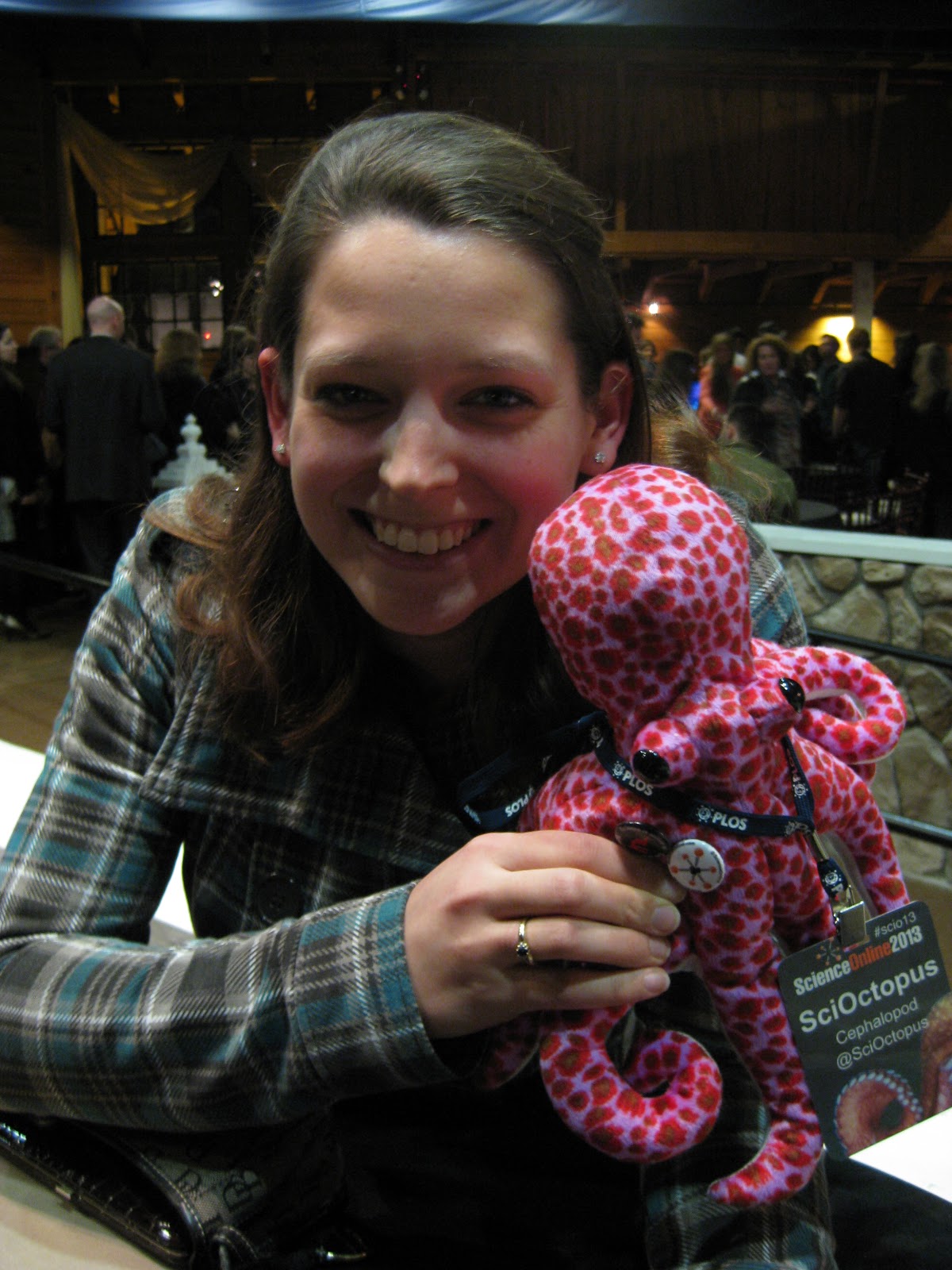 |
| I found SciOctopus! |
I most enjoyed the sessions on combining art and science (there were many) as well as a session on imposter syndrome. I also liked the instant feedback from the crowd on Twitter. Never would I have thought that people on their phones and laptops during a talk would be an awesome thing and not incredibly rude. I very quickly became one of those people. Sorry to anyone following me on Twitter that wasn't expecting a #scio13 tweet storm.
Overall, my experience was fantastic! I hope to go again next year, and maybe even moderate a session. I saw everything from dancing lemurs, to star parties, to famous science writers rocking out to Gangnam Style. I've never been to a conference where I've had too many dinner invitations because everyone was so welcoming, or to a conference where the attendees are so excited to see each other, they chat through the night and you find them bleary-eyed and still in the lobby the next morning. I met some of my heroes, made some new friends, and I learned a ton about all the cool stuff being done for science communication.
 |
| North Carolina Museum of Natural Sciences |
Some tips for newcomers:
No Fear. Everyone is there to have a good time!
Get a smartphone. Yes, I might be the only one left without one, but seriously, don't be like me.
Find a friend. I found out just before I left that two former colleagues of mine were also attending. It really helped having someone there who knew me. After the 156th time you say who you are and where you're from, it feels good to just be familiar with someone. The three of us didn't stick together often, but at the end of the day, it was great to check in.
Put yourself out there. My best night was tagging along with the oceans group for dinner. It was a random Twitter invitation that turned into a night of laughter.
Something I wish would improve for next year:
Discussion moderation. I know I'm not the only one who felt things in this department were a little helter-skelter. Karyn Traphagen even wrote a response piece about it here. Although I don't want the moderators to head the discussion, they do need to guide it. I was pretty frustrated when someone would ask a question and rather than moving on to someone who would answer it, the moderator would just hand the mic to the next speaker, regardless of it being a different direction of thought. What ended up happening is that questions would never be answered, or topics would never be developed. When the discussion is all over the place, not much gets accomplished by the session. In some sessions it was a bit like being a teacher in a kindergarten classroom.
Teacher: "What letter does the word 'Cat' begin with? Yes, Jimmy?"
Jimmy: "I have a brown dog."
Teacher: "Okay then."
I would love to see more direction from the moderators. They should shepherd the discussion, even if not by providing their own food for thought.
 |
| News Flask! Cookie |
Saturday, August 18, 2012
And sometimes life gets in the way
I want to write about cancer. Somehow tie my blog into it's horrors, but I can't. At least not right now. We all know that losing someone is painful. I don't need to write about that here.
A lot of things got put on hold this summer, and it's a struggle to get back into some of them. This is my first foot forward back into the blogosphere. Thanks for sticking with me.
A lot of things got put on hold this summer, and it's a struggle to get back into some of them. This is my first foot forward back into the blogosphere. Thanks for sticking with me.
Tuesday, June 12, 2012
Q&A with John Mackin, a Man Very Very Close to the ISS
 |
| Image credit: NASA/Lauren Harnett |
(News Flask) :How long have you been with NASA and what is your position there?
(John Mackin): I started at United Space Alliance (USA) in November of 2008. USA is NASA’s prime contractor for International Space Station and Space Shuttle operations.
I serve as the Attitude Determination and Control Officer (ADCO) for ISS. I manage the onboard systems that are used to determine where ISS is, how fast it is going, and how it is orientated (We refer to orientation as attitude). The second part of my job is making sure the ISS is maintaining the attitude which we command to it. This is very important because if the vehicle is not pointing in the correct direction or spinning out of control, it makes it really hard to generate power from solar arrays, or point antennas at communication satellites. Without a stable platform, we would not be able to do the scientific research that the station was created for.
This attitude control is either performed by firing thrusters located on the Russian modules and the attached logistics vehicles or by moving very heavy spinning discs to impart a torque on the station. The discs are referred to as Control Moment Gyros (CMGs) and are electrically powered. The latter type of control is used at least 90% of the time because it uses electricity generated onboard instead of propellant that has to be delivered. Different activities require different types of control and part of my job is managing the transition, or handover, from one control type to another. I interact a lot with our Russian counterparts because the thrusters are on their part of the ISS.
(NF): Recently the ISS has had a lot of new traffic with the Soyuz a couple weeks ago and now the SpaceX Dragon vessel. Does this mean good things for the future of the space station program?
(JM): In the last year, ISS has seen four regular crew launches on Soyuz, and a variety of resupply vehicles (Russia’s Progress, the European Space Agency’s Automated Transfer Vehicle (ATV) and Japan’s HTV). With the shuttle program completed, the only way to get materials back to the ground is strapping them in with the crew in the Soyuz (Progress, ATV, and HTV are all loaded with trash and burned up on re-entry). The Soyuz return segment is just large enough to fit 3 people, so it is very challenging to return experiments or used equipment. With the success of SpaceX’s Dragon, experiments on ISS can be packed up and returned to ground. Within two weeks, the experiments will be in the hands of the scientists who designed them. Some experiments will even be returned within 48 hours of returning to earth. NASA has purchased 12 more Dragon launches.
(NF): You said you played a role in the recent docking of the Soyuz. Can you tell me a little about that, what role you played and the work that goes into such a feat?
(JM): This was one of the most complicated Soyuz Dockings we’ve done. Before every major event on ISS, the engineers run analysis on how the structure of the ISS will respond to certain types of thruster maneuvers. For the Soyuz docking, it was found that part of the two required thruster maneuvers could cause problems for ISS. To work around this problem, we did four maneuvers instead of the normal two. Half of those maneuvers were performed by US computers. In between the maneuvers we had periods of CMG control and during the docking itself, ISS was in free drift. All in all, we changed how ISS attitude control was performed 10 times in 3 days. Furthermore, all of the attitude details change whenever a launch moves, so when SpaceX delayed until after Soyuz docking, the whole plan had to change. I worked a few shifts while we were developing the plan and I did a lot of the initial detail work. When I was done, seven days of shifts reviewed and improved the plan before it was finally executed.
(NF): How closely did your team work with the SpaceX program to guarantee success in launch and docking of the Dragon?
(JM): My position had a flight lead for Dragon, who had been working with a flight director and the SpaceX folks for over two years. My involvement was as a GPS specialist for ISS. We GPS to determine position, velocity, and attitude on ISS. SpaceX Dragon also uses GPS, and when GPS data is shared between vehicles, the relative distance can be determined with high accuracy. This is very important for rendezvous, so ISS has to maintain redundancy in the GPS system. After one of the two 10 year old ISS GPS units failed last year, we replaced both of them to be prepared for Dragon. One week out from dragon launch (on the day I was switching from night shift to day shift) one of the new GPS units failed. The next morning I came in for meetings with the engineers and over the weekend I was on call as plans were hammered out. Monday morning I arrived at 4am local as astronaut Don Petit was opening up the interior walls of ISS to remove and replace the failed GPS. Once the new GPS was up and running, we put it through its paces to make sure it was producing good data for dragon rendezvous. It started having some anomalous behavior just hours before dragon was ready to launch, so I got a couple middle of the night phone calls. We recovered the GPS unit and were go for Dragon launch with about an hour to spare.
(NF): Some say SpaceX is a threat to NASA, and some say it will bring much needed public attention to human space flight. With drastic budget cuts to NASA over the last few years, do you feel like private space travel will help or hurt the NASA programs?
(JM): SpaceX success is NASA success. They are providing a needed service to the space station program, by delivering and returning cargo to and from ISS. Also, by controlling their costs, they’re allowing NASA to free up money to build a human vehicle that can go further than low earth orbit. I think it’s great that it has brought some excitement to the general public, since so many people think that America is out of the space business.
(NF): Do you think that private cargo launches add anything to the world of space flight or how the ISS operates, or is it all just hype?
(JM): I think they’re providing a service and I look forward to the day when you don’t have to work for a government to research in low earth orbit. I am waiting to book my trip!
(NF): What's your favorite part of working at the Johnson Space Center in Houston?
(JM): There’re a lot of things I enjoy: problem solving, developing new and better ways to do things, flying the space station at night, giving tours to friends and family, really just being in mission control is one of my childhood dreams. The best part is that I get to contribute to the future of human space flight, it makes the graveyard shifts and late night GPS phone calls worth it.
(NF): Once you told me you eat lunch in the old mission control room. Is it true that it's encouraged for staff to take breaks in there as a tourist attraction?
(JM): I actually do a lot of training simulations in a room next to the old Apollo mission control. I like to stroll through there on my way to the fridge to pick up my lunch, it’s nice to see the tourists behind the glass, excited to hear about Apollo and men walking on the moon. I don’t actually eat in there though, my breaks only last as long as the ISS is not communicating to mission control, so it’s only a few minutes at a time. Also it’s a piece of history and technically the Smithsonian owns the room, so I don’t want to mess it up!
Thanks again, John, for taking some time out to talk with me! I hope someday you do get the chance to book your space flight trip!
Be sure to check back in the next few days for a closer look at budgetary threats to the ISS program and what it might mean for the future of the station; the last installment in our short space series.
Sunday, June 10, 2012
Space, Space, Space!
Space has been front and center in my life a bit lately, but it provides a welcome distraction from the current happenings in Wisconsin. Venus passed in front of the sun, the ISS had some new visitors, and a great science fiction writer passed into the cosmos. Sometimes I tend to avoid conversations about astronomy and space flight. Maybe it's because it's not my field and I don't feel totally confident about engaging with more experienced scientists, or maybe it's because I'm just generally more interested in topics Earthly-bound. With all the recent activity, however, I'm excited. Last night I lay down on a boardwalk in the dark in the middle of a marsh with my friends and we all stared at the sky in silence as a shiny beacon of human achievement traveled across the sky of stars. I remember crawling out of bed to watch the ISS fly over our house as a kid, my parents just as excited as I was. I felt that same shiver of amazement last night as we braved spiders and other nighttime creepy crawlies to see it. I hope you feel just as excited this week when we speak with John Mackin, Attitude
Determination and Control Officer (ADCO) for ISS about the recent ISS happenings later in the week. For now I hope you step outside tonight to take a peek at the fly over. Go here to find out the best time to see it in your area. In the Madison area you can check it out around 9:20 PM and again a little lower in the sky around 11:00 PM tonight.
And for now, in case you missed it:
In keeping with the theme of Richard Feynman, the FBI did not find Feynman's antics so amusing.
Over at Scientific American Blogs, Marc Kuchner interviews Congressman Robert Walker on how scientists should talk to Congress.
Caleb A. Scharf delves into not just the transit of Venus but the transit of other celestial bodies.
And the world lost a man who made science fiction mainstream and created a 70 year legacy of writing. Ray Bradbury will be dearly missed.
And for now, in case you missed it:
In keeping with the theme of Richard Feynman, the FBI did not find Feynman's antics so amusing.
Over at Scientific American Blogs, Marc Kuchner interviews Congressman Robert Walker on how scientists should talk to Congress.
Caleb A. Scharf delves into not just the transit of Venus but the transit of other celestial bodies.
And the world lost a man who made science fiction mainstream and created a 70 year legacy of writing. Ray Bradbury will be dearly missed.
Monday, May 28, 2012
Science book review: Surely you're joking, Mr. Feynman!

This classic bit of science literature came out before I was even a part of this world, but the stories still came to life when I read them. There was no lack of amusement throughout the chapters. Feynman would have made a pretty shaky choice for a boyfriend, but he loved women as much as his work, and they receive equal attention here. From strippers, to bar girls, to nude models, and even his wives, his life full of love comes through, at times in hilarious ways. He liked to jump right in, and seemed willing to try anything once. Not just a physicist, he was a painter, a drummer, a safe cracker, and a Casanova.
However amusing, this book was equally frustrating to read. The chapters are edited versions of taped conversations Feynman had with friend Ralph Leighton. At times this conversational writing gets difficult to slog though. Sometimes the stories have a climax, sometimes they just meander along into nothing. A few chapters in, I found myself wondering if I was going to make it through. As fascinating as the stories were, when they were hard to follow, it was hard for me to stay focused. This left me exhausted and more aware of annoyances. If there is anyone who has a right to brag about his life, it's Richard Feynman. Even so, he saw himself as a gift to everything he touched. Biology, courting, teaching; each of these he makes out to seem as if he waltzed in and made everything better with his brilliance. His immodesty comes off as abrasive at times in a culture where that attitude isn't encouraged. Perhaps he isn't wrong about the changes he envisions, but it's a viewpoint that's difficult to swallow when you don't have a personal context with the author.
Amazing are the accomplishments of one man. They are too many to list here, but just reading about how he saw the Nobel Prize as a burden more than a boon shows how much he worked for the love of it. He wanted to open every box and see how it worked. He faced the experts in his field with grace and trained new scientists with integrity.
He ends with lessons we could all take to heart. "The first principle is that you must not fool yourself--and you are the easiest person to fool. So you have to be very careful about that. After you've not fooled yourself, it's easy not to fool other scientists. You just have to be honest in a conventional way after that." As scientists, with limited funding and a lot at stake, we want to believe every bit of our work, but it takes a lot more courage to see when you are wrong. Not much is worse than when ideology trumps evidence.
Although I would never aspire to write with a Feynman's voice, the experience is akin to sitting down with him over some tea for a chat. There's something really profound to a style so intimate. It's the way I hope to be able to share my life with my grandkids. He simply shares his experiences, the lesson in each he leaves to someone else to figure out.
Wednesday, May 9, 2012
Picture of the Week: "Jewel Caterpillar"
 |
| Photo taken by Gerardo Aizpuru |
Wednesday, May 2, 2012
Picture of the Week: RSMAS Amateur Underwater Photography Competition
 | |
| Photograph courtesy Todd Aki, RSMAS |
Wednesday, April 11, 2012
Sending the Kardashians to Space
Way back in February, Dr. Kiki hosted Fraser Cain from Universe Today on the Science Hour. The topic was space, but the conversation was important for all branches of science. Though they may have thought they were talking about how to get more funding to explore the universe, in reality Dr. Kiki and Mr. Cain were scraping the surface of a bigger issue. Constantly, asking for more money is not a sustainable way for labs to function. Which is more important for rallying research support, money or popularity?
The point in the interview that really got to me was when Dr. Kiki tossed out the idea of sending the Kardashians to space, as it might be the only way to get America's attention. A silly quip, but perhaps it isn't too far off the mark. If that thought makes you throw up in your mouth a bit, you aren't alone. Imagine this: Kim steals Khloe's husband during Khloe's first space walk. Kris constantly complains about the food and worries that zero gravity makes Kim's hair look too puffy. It's sickening. But Americans would watch, and space flight would be a front and center topic.
Unfortunately, most lab work makes for really poor television. "Look television viewers, see that tiny silver band? It may have taken ten weeks of failed experiments to see it, but it's there! See, right there! Isn't it exciting?"
So how do we generate interest? What will get people excited, making them more willing to give private donations or vote to raise the proportion of government budgets dedicated to research? Some research groups have great models to raise funds or "awareness" as it is sometimes called. Most of these groups are tied to diseases like breast cancer and autism. It doesn't mean that other research isn't just as valid, but most research groups are failing at speaking to the average citizen.
The blogging community is advancing science communication by leaps and bounds. Projects like The Open Notebook bring more voices to the discussion. Internet users have more access to quality science journalism than ever before. As science writers, professional or no, we live in an exciting time; however, we are still failing to reach those who are not already seeking us out. I love my readers, but I also know that I am personally doing a poor job of reaching out to more than avid science readers and my parents. Public science fairs are great, but few people stumble upon them accidentally. When it comes down to it, Bill Nye is showing up in only a fraction of homes. If you look in the average American's window, the Kardashians will be staring back at you instead.
NASA knew what it was doing when it put an elementary school teacher in a shuttle in 1986. Every classroom tuned in; every American heart was captivated by the story. If the mission hadn't ended tragically, I'd bet that this approach would still be used to draw people in. If, as the rumors say, Ashton Kutcher is one of the first people on a chartered flight to space, I hope that he tapes the whole thing and puts it on YouTube; the more Likes, Shares, and Views the better.
We live in an age when "scientist" is being tossed around by some as a bad word. Many popular news venues have cut or reduced their science reporting departments. The ones still in existence are often drowned out by reporting that suggests scientists are fueled by greed and self-interest with the capacity to easily lie to the public. At many news sources, the only science reporting that makes it to print must be something that could kill you, make you lose weight, or help get you laid. Dear lovers of science, we are greatly to blame for this.
Where were we when creationism wiggled its way in to a science classroom? Where were we when CNN dropped its science department? Where were we when public funding for stem cell research faced cuts in several states? Many of us were here, online, yelling at the top of our lungs about these injustices, sitting in our echo chambers with fellow science lovers. Few of us were out in the public sharing our knowledge, sharing why we love science with those who don't already share that love. Maybe we don't need Kardashians in space to win back America's hearts, but we need to start playing the game.
At my day job, I like to throw around research findings like baseball recaps. "Hey, did you hear about the study where they revived 38,000 year old plants from permafrost and got them to flower?" At first this was met with wide eyed stares and quick returns back to how the Brewers pitched the night before, but after a few tries, another person joined the conversation. Now it's pretty effortless to chat about the cool science-y thing we saw on the internet the night before. Try it out at family dinners or waiting in line at the grocery store. Make science communication accessible, exciting, and above all commonplace. Maybe we will never have a country who's people can name more Nobel Prize winners than characters from Jersey Shore, but the more people understand about research, the better. Force science to be popular, and the rest will follow.
The point in the interview that really got to me was when Dr. Kiki tossed out the idea of sending the Kardashians to space, as it might be the only way to get America's attention. A silly quip, but perhaps it isn't too far off the mark. If that thought makes you throw up in your mouth a bit, you aren't alone. Imagine this: Kim steals Khloe's husband during Khloe's first space walk. Kris constantly complains about the food and worries that zero gravity makes Kim's hair look too puffy. It's sickening. But Americans would watch, and space flight would be a front and center topic.
Unfortunately, most lab work makes for really poor television. "Look television viewers, see that tiny silver band? It may have taken ten weeks of failed experiments to see it, but it's there! See, right there! Isn't it exciting?"
So how do we generate interest? What will get people excited, making them more willing to give private donations or vote to raise the proportion of government budgets dedicated to research? Some research groups have great models to raise funds or "awareness" as it is sometimes called. Most of these groups are tied to diseases like breast cancer and autism. It doesn't mean that other research isn't just as valid, but most research groups are failing at speaking to the average citizen.
The blogging community is advancing science communication by leaps and bounds. Projects like The Open Notebook bring more voices to the discussion. Internet users have more access to quality science journalism than ever before. As science writers, professional or no, we live in an exciting time; however, we are still failing to reach those who are not already seeking us out. I love my readers, but I also know that I am personally doing a poor job of reaching out to more than avid science readers and my parents. Public science fairs are great, but few people stumble upon them accidentally. When it comes down to it, Bill Nye is showing up in only a fraction of homes. If you look in the average American's window, the Kardashians will be staring back at you instead.
NASA knew what it was doing when it put an elementary school teacher in a shuttle in 1986. Every classroom tuned in; every American heart was captivated by the story. If the mission hadn't ended tragically, I'd bet that this approach would still be used to draw people in. If, as the rumors say, Ashton Kutcher is one of the first people on a chartered flight to space, I hope that he tapes the whole thing and puts it on YouTube; the more Likes, Shares, and Views the better.
We live in an age when "scientist" is being tossed around by some as a bad word. Many popular news venues have cut or reduced their science reporting departments. The ones still in existence are often drowned out by reporting that suggests scientists are fueled by greed and self-interest with the capacity to easily lie to the public. At many news sources, the only science reporting that makes it to print must be something that could kill you, make you lose weight, or help get you laid. Dear lovers of science, we are greatly to blame for this.
Where were we when creationism wiggled its way in to a science classroom? Where were we when CNN dropped its science department? Where were we when public funding for stem cell research faced cuts in several states? Many of us were here, online, yelling at the top of our lungs about these injustices, sitting in our echo chambers with fellow science lovers. Few of us were out in the public sharing our knowledge, sharing why we love science with those who don't already share that love. Maybe we don't need Kardashians in space to win back America's hearts, but we need to start playing the game.
At my day job, I like to throw around research findings like baseball recaps. "Hey, did you hear about the study where they revived 38,000 year old plants from permafrost and got them to flower?" At first this was met with wide eyed stares and quick returns back to how the Brewers pitched the night before, but after a few tries, another person joined the conversation. Now it's pretty effortless to chat about the cool science-y thing we saw on the internet the night before. Try it out at family dinners or waiting in line at the grocery store. Make science communication accessible, exciting, and above all commonplace. Maybe we will never have a country who's people can name more Nobel Prize winners than characters from Jersey Shore, but the more people understand about research, the better. Force science to be popular, and the rest will follow.
Friday, March 9, 2012
Picture of the Week: "Magic" Balancing Broomsticks

As a snarky and sometimes obnoxiously precocious kid, it was my favorite game to debunk Old Wives' Tales. I think I got this from my mother, who once sat for an hour watching ice in a full cup melt, just to prove to her own mother that it indeed would not overflow, no matter how much ice she added. My family still fills coffee pots with cold water and ice trays with hot water, despite my insistence that this does nothing more than waste your time and perhaps melt your frozen veggies. (However I've heard some tricky physics about the hot water to ice thing) Once, my dad insisted that on equinoxes you could balance an egg; a special day. That was my cue to run to the refrigerator to balance an egg on a random day. Equinox-schmequinox.
It really is a cool and fun experiment to do in a classroom. Give each kid an egg on the Equinox and challenge them to stand it up. It always works out and it's always neat. But there's just one thing...few people do the counter experiment to prove that it doesn't work on other days. Besides, who just keeps eggs laying around a classroom? So you go around thinking that the Equinox is special, but try it any other day and you will find that it still works. Go...go right now and balance an egg. It will work. And it might make you smile.
A broom however would be a great tool in a classroom. And maybe after giving it the daily balance test, your students might sweep up a little. I'm not sure that I understand why it works. This article on Wired.com gives some explanation. I also can't say if it's easier or harder on one day or another, but it would be a fun concept as a teacher or parent to test with kids. If you do know how it all works, feel free to educate me in the comments. I would love to learn more.
Despite that right now it appears that my Facebook is turning into this:

I believe there is a scientific, rather than magical (or seasonal) explanation to the surreal floating broomsticks. We, in my house however, have our calendars marked for the Summer Solstice, just to see for ourselves.
Monday, February 27, 2012
Science Book Review: The Poisoner's Handbook: Murder and the Birth of Forensic Medicine in Jazz Age New York
Whether you seek murder mysteries, failed romances, meticulous histories, or elaborate chemistry, Deborah Blum's The Poisoner's Handbook has something for you. Loosely following the works of medical examiner Charles Norris and chemist Alexander Gettler as they raced to stay ahead of poisoner's and poisons used in the early 1900's, this book jumps from one dangerous compound to another,fluidly weaving the stories of those involved.
At a time when alcohol was not only king but criminal as well, mercury, methanol, radium and even the drink (ethanol) itself killed thousands in New York City. Poisons were easy to come by but hard to prove in a court of law. Forensic medicine was new and difficult to explain to a jury. Why was this proof any more true than what the defense was saying against scientific evidence? As chemists became ever more driven to stop chemical criminals, prohibition itself seemed criminal enough for all the lives it took.
My favorite section was Radium. Marie Curie, one of the most respected woman scientists in history couldn't have known the harm her discoveries would bring. She was never without a sample in her pocket to show off to fellow scientists, a lovely, fascinating compound. So useful it was turned into "self-luminous" paint for the dials on watches. Women who painted the dials were equally fascinated and unafraid of radium. Not only did the women sharpen the paintbrushes with their mouths, Blum explains, "They sprinkled the luminous liquid in their hair to make their curls twinkle in the dark. They brightened their fingernails with it. One girl covered her teeth to give herself a Cheshire cat smile when she went home at night." Little did they know the substance would crumble their bones and cause leukemia.
I loved every moment of reading this book. Although it isn't a complete history of Prohibition, forensics, or any one character, it gives enough to get the reader involved in the story and excited about the science. My one wish for this book would be a set of full color images in the middle to go along with some of the tales. In fact, I was intrigued enough to look up one gruesome image described in the book taken by a sneaky photographer in an execution room. Those snapshots would have been a wonderful addition to the stories.
This book speaks to many audiences and is open enough for even the most novice science readers. Think of this book as a literary episode of 1920's CSI. The Poisoner's Handbook reads like fiction and is even greater because of its truth. I highly recommend it for anyone seeking a well spun tale.

At a time when alcohol was not only king but criminal as well, mercury, methanol, radium and even the drink (ethanol) itself killed thousands in New York City. Poisons were easy to come by but hard to prove in a court of law. Forensic medicine was new and difficult to explain to a jury. Why was this proof any more true than what the defense was saying against scientific evidence? As chemists became ever more driven to stop chemical criminals, prohibition itself seemed criminal enough for all the lives it took.
My favorite section was Radium. Marie Curie, one of the most respected woman scientists in history couldn't have known the harm her discoveries would bring. She was never without a sample in her pocket to show off to fellow scientists, a lovely, fascinating compound. So useful it was turned into "self-luminous" paint for the dials on watches. Women who painted the dials were equally fascinated and unafraid of radium. Not only did the women sharpen the paintbrushes with their mouths, Blum explains, "They sprinkled the luminous liquid in their hair to make their curls twinkle in the dark. They brightened their fingernails with it. One girl covered her teeth to give herself a Cheshire cat smile when she went home at night." Little did they know the substance would crumble their bones and cause leukemia.
I loved every moment of reading this book. Although it isn't a complete history of Prohibition, forensics, or any one character, it gives enough to get the reader involved in the story and excited about the science. My one wish for this book would be a set of full color images in the middle to go along with some of the tales. In fact, I was intrigued enough to look up one gruesome image described in the book taken by a sneaky photographer in an execution room. Those snapshots would have been a wonderful addition to the stories.
This book speaks to many audiences and is open enough for even the most novice science readers. Think of this book as a literary episode of 1920's CSI. The Poisoner's Handbook reads like fiction and is even greater because of its truth. I highly recommend it for anyone seeking a well spun tale.
Monday, February 20, 2012
Picture of the Week: A Look Inside a Rocket Military Factory
 |
| Photo Credit Lana Sator |
Wednesday, January 18, 2012
Picture of the Week: OLED TV Debuts at CES
 |
| Photo Credit: LG |
Wednesday, January 11, 2012
Picture of the Week: Lum the Red Panda
 |
| Photo Credit: Dane County and Henry Vilas Zoo |
Monday, January 9, 2012
Leaving Graduate School: Delicious Ambiguity
(Disclaimer: This is not a science news post, but a personal account of my choice to walk away from grad school. Regularly scheduled science will return on Wednesday, but until then be prepared for excessive use of the word "I.")
Quitting grad school. I don't know how many times I typed those very words into my Google search box. I was looking for someone else who'd been through it, just one person to tell me it would be okay. I heard a lot of "You'll regret it" and "Don't throw away this great opportunity." I didn't hear much of "This isn't for everyone" or "There are benefits to quitting." But I did feel like a failure, through and through. Still do sometimes if I let myself.
It didn't seem to matter how much I'd already accomplished or how much I hated it, I felt like it was my destiny. I was smart and accomplished and I didn't want to walk out of school with $120,000 in debt like my vet school friends. Grad school was the only real option for me, or so I thought at the time. I was in a competition with no one, fighting only myself.
My first semester was rough. I was in and then out of a dysfunctional relationship, missing my friends, and failing at focus. I knew that I didn't want to be there anymore, but I kept telling myself that it would all be better next semester. I convinced myself that the outside distractions were the real problem. As luck would have it, I got into my first choice lab, one of the best in the field. I told myself that this was the change I was looking for and that it would be smooth sailing from here. But it wasn't.
I was surrounded with solid mentors, friendly lab mates, a supportive program, and a stimulating project. I was in graduate school heaven. And yet, that tiny voice was still there in the back of my mind telling me that this wasn't right. The voice grew louder and louder and I grew angrier and more depressed. Why didn't I love it? How could the girl who had everything she worked hard for be so unhappy? So instead of blaming the rest of the world this time, I blamed myself. Grad school wasn't the problem; I was.
I'd beat myself up daily over failures. If an experiment didn't work, it was because I couldn't hack it. If I misunderstood a paper, it was because I was the dumbest person in the room. If I missed an opportunity for a grant, it was because I didn't deserve to be there in the first place. I honestly remember telling people that I felt I was at the bottom of my peers, but at least I was in the race at all. My self esteem went out the window, and after a couple years of self emotional abuse, I became numb. I couldn't bring myself to read the papers or run the experiments. I dreaded going to lab. And all of this only got worse the closer I inched to my preliminary exam.
When my exam day came, I had everything planned for my own demise. I was certain I was going to flop and be forced to leave the program. Yes, I'd studied and knew my stuff up and down, but my head was full of doubt. Instead my exam was stellar. How could that be? I reinvested myself in my work, banking off this molehill of confidence. My confidence took me elsewhere though, and I began to see the truth. I was and am a capable person. I was smart enough to excel and get myself into the program in the first place. But determination and perseverance trump intelligence in academia. Not to say that those in academia aren't smart, they are among the brightest in the world, but their tenacity sets them apart. Why should I be tenacious about an end goal I couldn't justify to myself anymore? If I knew I never wanted my boss's job then I didn't need to be there.
Now, in the aftermath of it all, I do have some regrets, but none worth three or four more years of unhappiness. No, I didn't leap into my dream job, and yes, I miss the people and the freedom that grad school allows, but I feel great about quitting. Maybe I can't be Dr. McDaniel this time around and for now that makes me incredibly happy. Gilda Radner said it best: "I wanted a perfect ending. Now I've learned, the hard way, that some poems don't rhyme, and some stories don't have a clear beginning, middle, and end. Life is about not knowing, having to change, taking the moment and making the best of it, without knowing what's going to happen next. Delicious ambiguity."
Quitting grad school. I don't know how many times I typed those very words into my Google search box. I was looking for someone else who'd been through it, just one person to tell me it would be okay. I heard a lot of "You'll regret it" and "Don't throw away this great opportunity." I didn't hear much of "This isn't for everyone" or "There are benefits to quitting." But I did feel like a failure, through and through. Still do sometimes if I let myself.
It didn't seem to matter how much I'd already accomplished or how much I hated it, I felt like it was my destiny. I was smart and accomplished and I didn't want to walk out of school with $120,000 in debt like my vet school friends. Grad school was the only real option for me, or so I thought at the time. I was in a competition with no one, fighting only myself.
My first semester was rough. I was in and then out of a dysfunctional relationship, missing my friends, and failing at focus. I knew that I didn't want to be there anymore, but I kept telling myself that it would all be better next semester. I convinced myself that the outside distractions were the real problem. As luck would have it, I got into my first choice lab, one of the best in the field. I told myself that this was the change I was looking for and that it would be smooth sailing from here. But it wasn't.
I was surrounded with solid mentors, friendly lab mates, a supportive program, and a stimulating project. I was in graduate school heaven. And yet, that tiny voice was still there in the back of my mind telling me that this wasn't right. The voice grew louder and louder and I grew angrier and more depressed. Why didn't I love it? How could the girl who had everything she worked hard for be so unhappy? So instead of blaming the rest of the world this time, I blamed myself. Grad school wasn't the problem; I was.
I'd beat myself up daily over failures. If an experiment didn't work, it was because I couldn't hack it. If I misunderstood a paper, it was because I was the dumbest person in the room. If I missed an opportunity for a grant, it was because I didn't deserve to be there in the first place. I honestly remember telling people that I felt I was at the bottom of my peers, but at least I was in the race at all. My self esteem went out the window, and after a couple years of self emotional abuse, I became numb. I couldn't bring myself to read the papers or run the experiments. I dreaded going to lab. And all of this only got worse the closer I inched to my preliminary exam.
When my exam day came, I had everything planned for my own demise. I was certain I was going to flop and be forced to leave the program. Yes, I'd studied and knew my stuff up and down, but my head was full of doubt. Instead my exam was stellar. How could that be? I reinvested myself in my work, banking off this molehill of confidence. My confidence took me elsewhere though, and I began to see the truth. I was and am a capable person. I was smart enough to excel and get myself into the program in the first place. But determination and perseverance trump intelligence in academia. Not to say that those in academia aren't smart, they are among the brightest in the world, but their tenacity sets them apart. Why should I be tenacious about an end goal I couldn't justify to myself anymore? If I knew I never wanted my boss's job then I didn't need to be there.
Now, in the aftermath of it all, I do have some regrets, but none worth three or four more years of unhappiness. No, I didn't leap into my dream job, and yes, I miss the people and the freedom that grad school allows, but I feel great about quitting. Maybe I can't be Dr. McDaniel this time around and for now that makes me incredibly happy. Gilda Radner said it best: "I wanted a perfect ending. Now I've learned, the hard way, that some poems don't rhyme, and some stories don't have a clear beginning, middle, and end. Life is about not knowing, having to change, taking the moment and making the best of it, without knowing what's going to happen next. Delicious ambiguity."
Wednesday, December 7, 2011
Picture of the Week: Last Day in Lab
 |
| Counting cells in my lab |
Wednesday, November 30, 2011
Picture of the Week: The Fairy Wasp

Photo Credit: A. Polilov
There has been a lot of buzz about this miniscule insect this week after a publication by Alexey Polilov demonstrated that the fairy wasp's nervous system operates with only 5% of the nucleated neurons of similar species. As you can see from the picture, which is on a 200 micron scale, the wasp is as tiny as some unicellular organisms such as the paramecium and the amoeba. The study showed that in order to exist as such a tiny multicellular creature, some structural sacrifices must be made. Thus, the loss of the nuclei from the nerve cells. This aquatic wasp is so incredibly tiny that it lays its eggs inside the eggs of other insects that also live in ponds. For more on this tiny creature, read Ed Yong's overview of this paper at Discover Blogs.
Subscribe to:
Posts (Atom)