Pages

Showing posts with label Science communication. Show all posts

Thursday, February 21, 2013

Wake Up Call


ScienceOnline Logo candy
It's been half a year since I found myself writing a blog post. My inspiration lies with ScienceOnline2013. Self-described, this conference in Raleigh, North Carolina is "Conversation, Community, & Connections at the Intersection of Science & the Web." I would describe it as meeting the family you never knew you had.

The travel gods shined on me as I made my way across the country through all the storms. Although I'd had many online conversations with other attendees, I really had never met almost any of them face to face. It can be pretty intimidating walking into a room full of (or sharing a hotel room with) a bunch of strangers. It can also be a bit strange knowing who someone else is before you even say hello, especially when no one knows you.
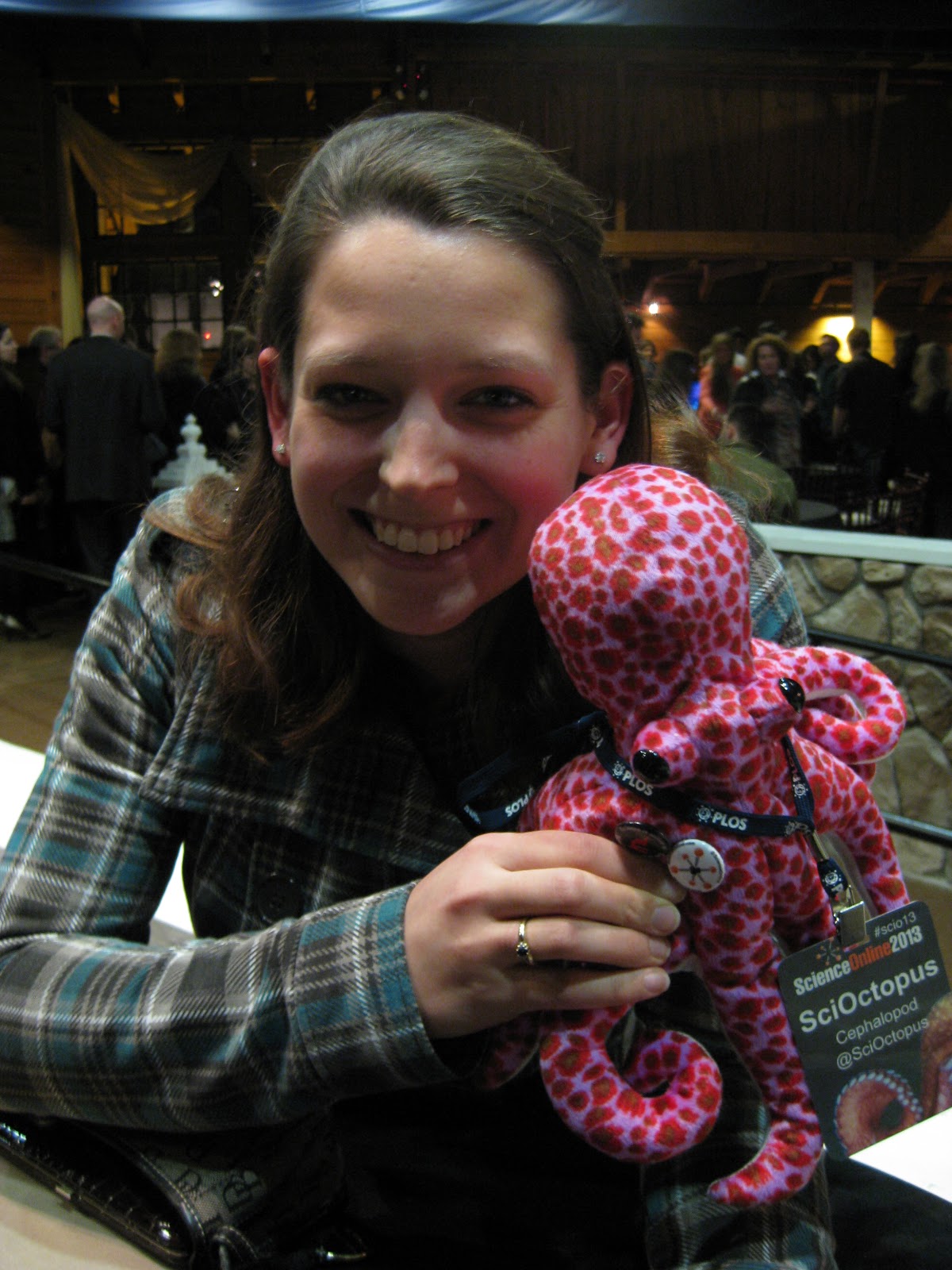
I found SciOctopus!
Yes, I was a newcomer. But as it turns out, so were about half of the people there. For me, this made things easier. You make fast friends when everyone is looking for someone to talk to. Actually, even seasoned veterans of ScienceOnline were just as welcoming. Part of this due to how the conference is structured. All titles are stripped when you walk through the door and all that remains is your first name and your Twitter handle. No, this doesn't make everyone anonymous, but it does make everyone seem more approachable. Why not talk to Fraser Cain, Carl Zimmer, or Maryn McKenna? During the sessions, everyone gets a voice. The morning Converge sessions were the only times when there was a simple speaker/audience format. The rest of the conference was divided into workshops and discussions.

I most enjoyed the sessions on combining art and science (there were many) as well as a session on imposter syndrome. I also liked the instant feedback from the crowd on Twitter. Never would I have thought that people on their phones and laptops during a talk would be an awesome thing and not incredibly rude. I very quickly became one of those people. Sorry to anyone following me on Twitter that wasn't expecting a #scio13 tweet storm.

Overall, my experience was fantastic!  I hope to go again next year, and maybe even moderate a session.  I saw everything from dancing lemurs, to star parties, to famous science writers rocking out to Gangnam Style. I've never been to a conference where I've had too many dinner invitations because everyone was so welcoming, or to a conference where the attendees are so excited to see each other, they chat through the night and you find them bleary-eyed and still in the lobby the next morning. I met some of my heroes, made some new friends, and I learned a ton about all the cool stuff being done for science communication.

North Carolina Museum of Natural Sciences

Some tips for newcomers:

No Fear. Everyone is there to have a good time!

Get a smartphone. Yes, I might be the only one left without one, but seriously, don't be like me.

Find a friend. I found out just before I left that two former colleagues of mine were also attending. It really helped having someone there who knew me. After the 156th time you say who you are and where you're from, it feels good to just be familiar with someone. The three of us didn't stick together often, but at the end of the day, it was great to check in.

Put yourself out there. My best night was tagging along with the oceans group for dinner. It was a random Twitter invitation that turned into a night of laughter.

Something I wish would improve for next year:

Discussion moderation. I know I'm not the only one who felt things in this department were a little helter-skelter. Karyn Traphagen even wrote a response piece about it here. Although I don't want the moderators to head the discussion, they do need to guide it. I was pretty frustrated when someone would ask a question and rather than moving on to someone who would answer it, the moderator would just hand the mic to the next speaker, regardless of it being a different direction of thought. What ended up happening is that questions would never be answered, or topics would never be developed. When the discussion is all over the place, not much gets accomplished by the session. In some sessions it was a bit like being a teacher in a kindergarten classroom.

Teacher: "What letter does the word 'Cat' begin with? Yes, Jimmy?"
Jimmy: "I have a brown dog."
Teacher: "Okay then."

I would love to see more direction from the moderators. They should shepherd the discussion, even if not by providing their own food for thought.


News Flask! Cookie
SciO13 was a wake up call for me. If science communication is what I want to do, I need to be online: blogging, reading, commenting. My previous job left me exhausted and joys and sorrows in life made things complicated. Now I feel like I have a handle on things (sort of) and I will be posting at least once a week. I'm sure that my blog will take a turn toward science education, since that's what I'm working on in real life, but there will still be plenty of research reporting, book reviews, and loads of links to people doing cool stuff.

Sunday, June 10, 2012

Space, Space, Space!

Space has been front and center in my life a bit lately, but it provides a welcome distraction from the current happenings in Wisconsin. Venus passed in front of the sun, the ISS had some new visitors, and a great science fiction writer passed into the cosmos.  Sometimes I tend to avoid conversations about astronomy and space flight. Maybe it's because it's not my field and I don't feel totally confident about engaging with more experienced scientists, or maybe it's because I'm just generally more interested in topics Earthly-bound. With all the recent activity, however, I'm excited. Last night I lay down on a boardwalk in the dark in the middle of a marsh with my friends and we all stared at the sky in silence as a shiny beacon of human achievement traveled across the sky of stars. I remember crawling out of bed to watch the ISS fly over our house as a kid, my parents just as excited as I was. I felt that same shiver of amazement last night as we braved spiders and other nighttime creepy crawlies to see it. I hope you feel just as excited this week when we speak with John Mackin, Attitude Determination and Control Officer (ADCO) for ISS about the recent ISS happenings later in the week. For now I hope you step outside tonight to take a peek at the fly over.  Go here to find out the best time to see it in your area. In the Madison area you can check it out around 9:20 PM and again a little lower in the sky around 11:00 PM tonight. 

And for now, in case you missed it:

In keeping with the theme of Richard Feynman, the FBI did not find Feynman's antics so amusing.  


Over at Scientific American Blogs, Marc Kuchner interviews Congressman Robert Walker on how scientists should talk to Congress. 


Caleb A. Scharf delves into not just the transit of Venus but the transit of other celestial bodies


And the world lost a man who made science fiction mainstream and created a 70 year legacy of writing. Ray Bradbury will be dearly missed.

Wednesday, April 11, 2012

Sending the Kardashians to Space

Way back in February, Dr. Kiki hosted Fraser Cain from Universe Today on the Science Hour. The topic was space, but the conversation was important for all branches of science. Though they may have thought they were talking about how to get more funding to explore the universe, in reality Dr. Kiki and Mr. Cain were scraping the surface of a bigger issue. Constantly, asking for more money is not a sustainable way for labs to function. Which is more important for rallying research support, money or popularity? 

The point in the interview that really got to me was when Dr. Kiki tossed out the idea of sending the Kardashians to space, as it might be the only way to get America's attention. A silly quip, but perhaps it isn't too far off the mark. If that thought makes you throw up in your mouth a bit, you aren't alone. Imagine this: Kim steals Khloe's husband during Khloe's first space walk. Kris constantly complains about the food and worries that zero gravity makes Kim's hair look too puffy. It's sickening. But Americans would watch, and space flight would be a front and center topic.

Unfortunately, most lab work makes for really poor television. "Look television viewers, see that tiny silver band? It may have taken ten weeks of failed experiments to see it, but it's there!  See, right there!  Isn't it exciting?"

So how do we generate interest?  What will get people excited, making them more willing to give private donations or vote to raise the proportion of government budgets dedicated to research? Some research groups have great models to raise funds or "awareness" as it is sometimes called. Most of these groups are tied to diseases like breast cancer and autism. It doesn't mean that other research isn't just as valid, but most research groups are failing at speaking to the average citizen.

The blogging community is advancing science communication by leaps and bounds. Projects like The Open Notebook bring more voices to the discussion. Internet users have more access to quality science journalism than ever before. As science writers, professional or no, we live in an exciting time; however, we are still failing to reach those who are not already seeking us out. I love my readers, but I also know that I am personally doing a poor job of reaching out to more than avid science readers and my parents. Public science fairs are great, but few people stumble upon them accidentally. When it comes down to it, Bill Nye is showing up in only a fraction of homes. If you look in the average American's window, the Kardashians will be staring back at you instead.

NASA knew what it was doing when it put an elementary school teacher in a shuttle in 1986. Every classroom tuned in; every American heart was captivated by the story. If the mission hadn't ended tragically, I'd bet that this approach would still be used to draw people in. If, as the rumors say, Ashton Kutcher is one of the first people on a chartered flight to space, I hope that he tapes the whole thing and puts it on YouTube; the more Likes, Shares, and Views the better.

We live in an age when "scientist" is being tossed around by some as a bad word. Many popular news venues have cut or reduced their science reporting departments. The ones still in existence are often drowned out by reporting that suggests scientists are fueled by greed and self-interest with the capacity to easily lie to the public. At many news sources, the only science reporting that makes it to print must be something that could kill you, make you lose weight, or help get you laid. Dear lovers of science, we are greatly to blame for this.

Where were we when creationism wiggled its way in to a science classroom?  Where were we when CNN dropped its science department? Where were we when public funding for stem cell research faced cuts in several states?  Many of us were here, online, yelling at the top of our lungs about these injustices, sitting in our echo chambers with fellow science lovers. Few of us were out in the public sharing our knowledge, sharing why we love science with those who don't already share that love. Maybe we don't need Kardashians in space to win back America's hearts, but we need to start playing the game.

At my day job, I like to throw around research findings like baseball recaps. "Hey, did you hear about the study where they revived 38,000 year old plants from permafrost and got them to flower?" At first this was met with wide eyed stares and quick returns back to how the Brewers pitched the night before, but after a few tries, another person joined the conversation. Now it's pretty effortless to chat about the cool science-y thing we saw on the internet the night before. Try it out at family dinners or waiting in line at the grocery store. Make science communication accessible, exciting, and above all commonplace. Maybe we will never have a country who's people can name more Nobel Prize winners than characters from Jersey Shore, but the more people understand about research, the better. Force science to be popular, and the rest will follow.