A nation stands divided. Many worry that it will never be united again. The government no longer functions efficiently, and the President, though embattled, still addresses his people with pride and more importantly, hope.
This is not 2013. It's 1863; March 3, 1863 to be precise. On this day, in the course of 24 hours, the Act of Incorporation is presented, passed through the House and Senate, and signed by Abraham Lincoln, creating the US National Academy of Sciences.
The American Civil War was arguably not a scientific war. Although new essential technologies emerged, the need for physicists, chemists, and biologists was not apparent to the US or Confederate governments. Even with the attitude that scientific discovery was superfluous to the country's goals, some elected officials recognized it's importance to America's future and many famous scientific organizations were developed around this time. Strong voices called out. demanding that science have a place, and NAS, AAAS, and the Smithsonian Institute were formed.
Here we stand as a country, 150 years later, watching funding for science slashed by the sequester. The public's attitude has only become more favorable toward scientific advancement, not just in the US but worldwide. Research being conducted in industry, at academic institutions, and in our classrooms has permeated nearly every area of our lives. From medicine, to defense, down to the food we eat and the ways we communicate, scientific thought, research, and development is essential to our way of life.
Less than a month ago, the science community cheered as President Obama addressed the nation:
"If we want to make the best products, we also have to invest in the best ideas. Every dollar we invested to map the human genome returned $140 to our economy. Today, our scientists are mapping the human brain to unlock the answers to Alzheimer’s; developing drugs to regenerate damaged organs; devising new material to make batteries ten times more powerful. Now is not the time to gut these job-creating investments in science and innovation. Now is the time to reach a level of research and development not seen since the height of the Space Race."
In a Pew Research Center survey, 77% of those polled wish to increase or keep science funding at current levels. Even with the party divide, only 32% of Republicans polled asked for cuts to science funding. Yet, starting today, the National Institutes of Health (NIH) alone will see a cut of $1.6 billion. The National Science Foundation (NSF), the Department of Energy’s Office of Science, and NASA together will lose $900 million. This means fewer grants will be awarded, many grants previously awarded will no longer be honored, and fewer jobs will be created in the coming years. Even if the sequester is resolved in the coming months, the damage it's caused will affect the science world for years.
Even scientists with excellent grant scores are in jeopardy. The grant pool is being called a lottery by some. Funding shortages are nothing new, and at both the NIH and the NSF, funding rates were at all time lows last year. Although cuts due to the sequester only represent around 5% of the budgets for these organizations, they've been running on shoe-string budgets for a decade.
The unintended consequence is that the United States will cut its innovators first. Something most people don't know about science funding is that it's not always fair. Just as a company will hand a pink slip to a new employee in favor of keeping someone with a proven track record, grant awards often go to the labs with the most promising history, and not necessarily the labs with the most exciting ideas. Because funds are so limited, grant reviewers require preliminary data showing that your idea will work, a small guarantee that they are putting their money in the right place. As a brand new Ph.D., this can be the biggest mountain to climb. How do you collect data to prove that your idea will work when you don't have the money to test it?
For many Americans, these problems aren't even on the radar, and because many of the consequences are long-term, most of the public won't have first hand experience with them until sometime in the future. There will come a day when your father's cancer treatment is revoked because the clinical trial was cancelled, or you contract a new strain of flu that could have been prevented if the lab creating new vaccines hadn't faced cutbacks. By this point however, the damage will be very deep.
Even in our broader communities, the roots of science will be stifled. Wisconsin alone stands to lose $40.8 million for K-12 education. The National Park Service will need to reduce hours to compensate for losses. Undergraduate financial aid will take a hit at the UW-Madison as well. All across the country, our future innovators won't even have the opportunity show us what they can do. Science infiltrates every bit of our lives, right down to the way we think, and the sequester threatens that way life.
Please help to fight the sequester by writing to your senators and representatives.
If you live here in Wisconsin
Tammy Baldwin
Ron Johnson
If you live elsewhere in the US, you can enter your zip code here and it will provide contact info for you:
http://act.secondtonone.org/6059/stop-sequestration/
For more information about how the sequester relates to science:
Looming Government Cuts "Unmitigated Disaster" for Life Sciences
Starvation Diet
AAAS Estimation of R&D Cuts

Friday, March 1, 2013

Thursday, February 21, 2013
Wake Up Call
 |
| ScienceOnline Logo candy |
The travel gods shined on me as I made my way across the country through all the storms. Although I'd had many online conversations with other attendees, I really had never met almost any of them face to face. It can be pretty intimidating walking into a room full of (or sharing a hotel room with) a bunch of strangers. It can also be a bit strange knowing who someone else is before you even say hello, especially when no one knows you.
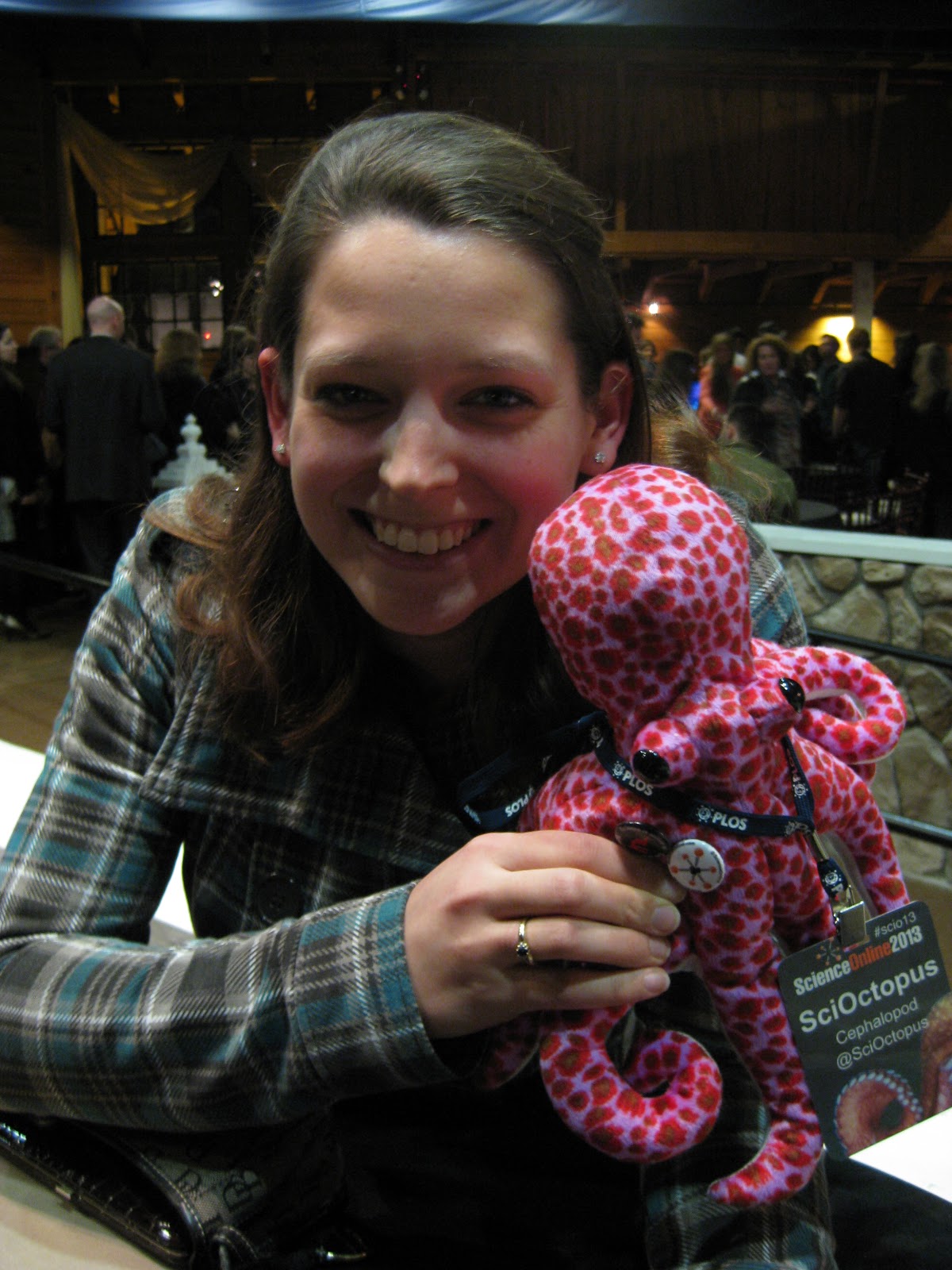 |
| I found SciOctopus! |
I most enjoyed the sessions on combining art and science (there were many) as well as a session on imposter syndrome. I also liked the instant feedback from the crowd on Twitter. Never would I have thought that people on their phones and laptops during a talk would be an awesome thing and not incredibly rude. I very quickly became one of those people. Sorry to anyone following me on Twitter that wasn't expecting a #scio13 tweet storm.
Overall, my experience was fantastic! I hope to go again next year, and maybe even moderate a session. I saw everything from dancing lemurs, to star parties, to famous science writers rocking out to Gangnam Style. I've never been to a conference where I've had too many dinner invitations because everyone was so welcoming, or to a conference where the attendees are so excited to see each other, they chat through the night and you find them bleary-eyed and still in the lobby the next morning. I met some of my heroes, made some new friends, and I learned a ton about all the cool stuff being done for science communication.
 |
| North Carolina Museum of Natural Sciences |
Some tips for newcomers:
No Fear. Everyone is there to have a good time!
Get a smartphone. Yes, I might be the only one left without one, but seriously, don't be like me.
Find a friend. I found out just before I left that two former colleagues of mine were also attending. It really helped having someone there who knew me. After the 156th time you say who you are and where you're from, it feels good to just be familiar with someone. The three of us didn't stick together often, but at the end of the day, it was great to check in.
Put yourself out there. My best night was tagging along with the oceans group for dinner. It was a random Twitter invitation that turned into a night of laughter.
Something I wish would improve for next year:
Discussion moderation. I know I'm not the only one who felt things in this department were a little helter-skelter. Karyn Traphagen even wrote a response piece about it here. Although I don't want the moderators to head the discussion, they do need to guide it. I was pretty frustrated when someone would ask a question and rather than moving on to someone who would answer it, the moderator would just hand the mic to the next speaker, regardless of it being a different direction of thought. What ended up happening is that questions would never be answered, or topics would never be developed. When the discussion is all over the place, not much gets accomplished by the session. In some sessions it was a bit like being a teacher in a kindergarten classroom.
Teacher: "What letter does the word 'Cat' begin with? Yes, Jimmy?"
Jimmy: "I have a brown dog."
Teacher: "Okay then."
I would love to see more direction from the moderators. They should shepherd the discussion, even if not by providing their own food for thought.
 |
| News Flask! Cookie |
Saturday, August 18, 2012
And sometimes life gets in the way
I want to write about cancer. Somehow tie my blog into it's horrors, but I can't. At least not right now. We all know that losing someone is painful. I don't need to write about that here.
A lot of things got put on hold this summer, and it's a struggle to get back into some of them. This is my first foot forward back into the blogosphere. Thanks for sticking with me.
A lot of things got put on hold this summer, and it's a struggle to get back into some of them. This is my first foot forward back into the blogosphere. Thanks for sticking with me.
Subscribe to:
Posts (Atom)